Pages

Showing posts with label negative energy. Show all posts

Wednesday, January 11, 2012

The Energy Equation that Physicists Don’t Fully Trust

Physicists have discovered that nature has a beautiful feature not only aesthetically but also mathematically which they call symmetry. The simplest symmetry we may get in nature is the pairing of fundamental particles such as that of particles-antiparticles or more complex [super] symmetry bosons-fermions. Even today physicists still tirelessly chase another particle’s symmetry i.e. super-partner particles which they yet find none.
  
Strangely enough, physicists don’t believe on the symmetry of energy, the most fundamental element of the reality, albeit the relativistic energy equation E2=m2c4+p2c2, plainly shows otherwise. This formula shows us the evidence that the energy exists in pairing - the positive and negative energy – regardless they are neatly separated or not from each other.

For physicists, the existence of negative energy together with the positive energy is bad news as such a situation may lead to a spontaneous transition from positive to negative energy resulting in a catastrophic instability. Alas, one cannot preserve the positive frequency requirement in quantum mechanics whose wavefunctions are essentially complex a). The two square roots of a complex number expression do not tend to separate neatly into positive and negative in a globally consistent way as what the physicists have expected1.  

Are we, then, faced with an impasse situation? Well, on everybody surprise we are absolutely not. On the contrary, the existence of the positive and negative energies is a fundamental feature that nature requires for the creation and reproduction of everything in the universe. Without such an opposite pair, the world would be sterile from anything material in which space and time have no meaning.


As far as the mainstream physics keep adopting the current single block b) universe "containing" no negative but positive energy to represent the actual world (Figure-1), we would forever stay with the crisis that today physicists are facing.

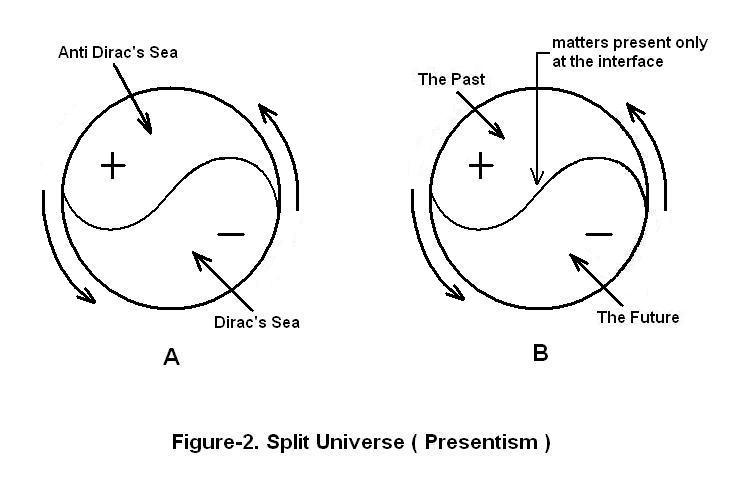
Even when Dirac proposed the existence of the ocean of [occupied] negative energy state c), nobody was cautious enough to give this Dirac’s sea its proper geographical place in the spacetime which should be next to the positive energy ocean, the anti-Dirac’s sea (Figure-2A).
Sooner or later, the mainstream physicists should adopt a 4-dimensional split universe in which the positive and negative energy exist together separated by a 3-dimensional interface (4-dimensional hypersurface with a very thin thickness d)) in between.
As we have previously elucidated, such interface does not separate neatly the positive and negative in a globally consistent way, in the sense that it e is extremely unstable.  It even barely exists, perpetually appears and disappears in and out of the existence.
This 3-dimensional interface, the physical space that we experience in, is nothing but the unit of time we call the present time (Figure-2B). The perpetual formation and dissolution of this present time are what we usually perceive as the time passage. It is such an idea that philosophers call presentism.
As in Galilean dynamics, we have not just one space but a different space e) for each moment in time. Space evaporates completely as one moment passes, and reappears as a completely different space as the next moment arrives 2. It is the factual reality that, alas, the mainstream physicists including Penrose himself rule out.
The material things exist strictly in the 3-dimensional interface (the present time), not in the outside of it. Matters appear and disappear at this 3-dimensional "screen" as the projection of the positive and negative energy interaction. In a close look, even in the place where there is no matter we can see virtual particles briefly jiggling violently in and out of the existence.
The 3-dimensional "interfacial tension" which keeps away the interface [and all matter within] from falling apart is what we call the gravitational constant. There are no such gravitational waves that propagate across the spacetime. Their propagation is limited to this sheet of the 3-dimensional interface which appears and disappears "through time" as a single whole.
Finally, this 3-dimensional interface which thickness is equal to the Planck distance (10-33 cm), the thinnest scale that nature allows, is perpetually created and annihilated at the rate equal to the speed of light, an enigmatic constant that physicists hitherto has taken as a gift from above. Naturally, no matter can move exceeding the speed limit that is equal to the rate of its perpetual creation [and annihilation].
Notes:
a.  In quantum mechanics, the momentum p may be replaced (quantization trick) by -iħ∂/∂x
b. Sometimes it is called a block universe. In such a world, matters may exist throughout the whole spacetime in an equal footing put in order by a light-cones framework. There is no definite place for the present time, past and future in such a framework, which Einstein worried so much. Philosophers call such a block universe’s idea eternalism.

c.  After he finally became convinced that the negative frequency solutions of the relativistic energy formula cannot be [mathematically] eliminated.
d.    The thickness (in the direction of its fourth dimension) of this interface is about 10-33 cm in which the quantum mechanics prevails.
e.   Even Minkowski described his spacetime in a similar way 3: "we should then have in the world no longer space, but an infinite number of spaces, analogously as there are in three-dimensional space an infinite number of planes. Three-dimensional geometry becomes a chapter in four-dimensional physics". Had he added that all those spaces are just potential - no matter of their normal directions point to - and only one space appears in a brief moment, he would be presentist.
References:
1.    Penrose. R.: "The Road to Reality," Vintage Books, London, 2005, p. 614-616.
2.    Ibid, p. 387
3.    Einstein, A. et al.: "The Principle of Reality," Dover Publication Inc.,  New York, 1952, p.79-80.Bottom of Form


Share/Bookmark

Sunday, September 25, 2011

Superstring Theory and the Seven Heavens

The superstring theory indicates for the first time the existence of multidimensional universes. It is supposed to be able to provide a comprehensive explanation of all known physical phenomena and answers the questions that the Big Bang theory cannot do: What happened before the creation (Big Bang)? Why did the universe explode?

 According to the superstring theory the universe initially existed in ten dimensions. However, because the ten-dimensional universe was unstable a), it creaked into two pieces, i.e. a four- and a six-dimensional universe 1. The ordinary four dimensions well extended while the other six extra dimensions shrunk and curled to an incredibly small size (10-33 cm), the reason why humans can not reach it.

Most physicists have deeply penetrated the mathematical aspect of the theory, but when come to translate it into physical reality it happened that they did it very lightly and carelessly. How come that a ten-dimensional body can be split in two to get a four- and a six-dimensional body? Surprisingly, nobody challenges and fixes such a bizarre idea. The perturbation theory, or whatever theory it is, would certainly fail to break a ten-dimensional body down to a four- and a six-dimensional body.

Let take an example of a three-dimensional body, say a cube of cheese. If we split it in two, indeed we did not get a thin piece of cheese and a fiber-like cheese (Figure-1A). In order to get a fiber-like form, we should make a series of slices; the first slices produce thin pieces of cheese, and the subsequent slices produce fibers of cheese (Figure-1B).


Now, how do we get a four-dimensional universe from the original ten-dimensional one? As the string theory postulated, the original ten-dimensional universe was so unstable that it broke in two parts. However, instead of creating one four- and one six-dimensional universe, a nine-dimensional universe was created in between the two separated parts of the original universe b). A series of subsequent splits took place successively in a similar way from higher down to the lower-dimensional universe.

In the end, we have a total of seven universes c), the one embedding the other in a successive lowering order of their dimensions.  As such, there is a ten-dimensional universe at the outermost embedding nine-dimensional one, the later embedding eight-dimensional one and so forth. At the end of the series we get the four-dimensional universe embedding a rotating ephemeral three-dimensional space, where we live in, perpetually appearing and disappearing across it (Figure-2) d).


Each universe contains the qualities and interactions of the one above, so that each descending level of the universe is in turn under more laws, more complex, and having much more varieties of kinds of stuff. It is the underlying purpose of the grand unification which hardly any physicist is aware. Regressing such cosmic creation process to the original condition of the ten-dimensional universe would give us a much simple physical law with fewer quantum kinds of stuff in it e).

Why, then, we cannot directly experience these extra higher-dimensional worlds? Just because the extra dimensions are temporal, not curly spatial dimensions as what the superstring theory hypothesizes. Each universe has its owned light f) with its corresponding speed (ci), Planck constant (hi) and gravity constant (Gi), depending on the degree of its dimensions.

The brane theory, as the extension of the superstring theory, should be adjusted accordingly. We better regard a brane as an interface lies between two [liquid-like] bodies, instead of a piece of paper floating in thin air. The brane’s dimensions which extend along its surface are spatial and off of it temporal.

The gravity fields propagate along the surface of the brane and not in the direction off of it as the brane theorists hypothesize 2. We should, therefore, regard parallel branes as two sides of the same brane; otherwise, they coexist in different time which is absurd.

Notes:
a)    The superstring theory cannot elaborate on the reason why such a universe is inherently unstable. The bold answer to that is that the energy intrinsically consists of the opposites, the positive and negative energy. These two parts tend to segregate arousing [rotational] opposite motions within and eventually the universe creaks into two pieces.
b)  We may easily imagine this phenomenon as a separation of oil and water creating an interface in between. However, instead of three-dimensional, we have here ten-dimensional oil-water system.
c)    The ancient term of such worlds was the seven heavens
d)    The knowledge of such cosmic structure has been known since the antiquity but degraded as time evolves to become just that of the planetary orbits of our solar system. The conflicting misinterpretation of such gigantic macro-cosmic concept, which was beyond both the church and Galileo's imagination, had tragically taken Galileo's life.
e)   Peter Freund, one of the pioneers, worked in multidimensional space, even though he did not know about the geometrical structure of such worlds, accurately stated that the laws of nature become simpler and elegant when formulated in higher dimensions.
f)    In the ancient relative term: light upon lights.

References:
1. Kaku, M.:" Hyperspace," Anchor Books, Doubleday, New York, 1994, p. 195, 207.
2. Randall, L.:" Warped Passage," Harp


Share/Bookmark

Wednesday, April 6, 2011

The Brane Theory as It should be

The brane theory is the derivative of the string theory, a mathematical model which was built to simulate the empirical particle interactions. The theory holds on the premise that the most basic indivisible objects underlying all matter are tiny vibrating segments or loops of the one-dimensional string-like entity.
In its later development, string theorists discovered that the strings do not freely move throughout the whole spacetime continuum but are constrained along the surface of membrane-like objects, coined as "branes," whose dimensions may extend over some, but not all of their embedding space's dimensions.
The branes are not just loci of matters and forces interactions, but also real objects which can be slack, wiggling and moving, or stretched tight. Branes are distinguished not only by the number of their dimensions in which they extend but also by their charges, their shape and tension1.
Despite the development intensity of the theory, the brane theorists are not yet to know whether their branes exist in the real world. They are like a blind man wondering about the big picture of the elephant after having felt the ear and the trunk of such animal.
1.   The spontaneously symmetry breaking of the spacetime
The brane theory proves that the spacetime world model as currently conceptualized is wrong. It is the existence of a 3-brane embedded in such spacetime that makes the latter's dimensions differentiated. Otherwise, the spacetime's dimensions are equal, in the sense that the spacetime is perfectly symmetric, homogeneous and isotropic a).
Paradoxically, as Lisa Randall remarked, many physicists think otherwise2:" They did not want to include branes in a physical realization of string theory because brane violated their intuition that all dimensions are created equal. Brane distinguishes certain dimensions – those along the brane are different from those that extend off it – whereas the known laws of physics treat all directions the same. Why should string theory be different?”
In fact, following the Minkowski’s discovery [1908] on the inextricability of the space and time, physicists have confusedly taken for granted the inequality of the dimensions of the spacetime, the union of the space and time3. They thought that the light cone system set up in every point within such spacetime could establish order and preserve the causality.
The special relativity, as currently conceptualized, is inconclusive. In order to explain the inequality of such continuum's dimensions, the physicists should include in their world creation scenario the spacetime's spontaneous broken symmetry. As it happens, the 3-brane comes into being in between the two spacetime's distinct halves, in which the dimensions along the brane become spatial and those off it temporal dimensions.
It is just like the separation of oil and water which we can observe in our daily [3-dimensional ambient] life b). The dimensions along the interface, because of the effect of the interfacial tension, would be different from those off it.
The gravity constant (G) that we are familiar with is nothing but the interfacial tension of the 3-brane embedded in 4-spacetime. Consequently, the gravity field like the other classical fields is trapped along the brane, not propagate off it as what the brane theory currently assumes c). The fields that may propagate off the brane are quantum fields including those of Higgs.
2.   Why a brane traps matter and classical fields?
Randall took for the analogy of trapping matter on a brane among other things water droplets on a shower curtain which travel only along the curtain's surface.
We wish here to provide a better and physically more appropriate analogy for describing the braneworld model. Matters are analogous to tiny flashes appearing and disappearing on the surface of a giant TV-screen.  The impact of streams of electrons fired onto and hit the screen resulting in the generation of these tiny flashes.

The seemingly trapped matters on the brane are tiny sparks appear and disappear on the TV screen-like brane. These tiny sparks, which are quantum in sized), are generated as the effect of the quantum fields (Higgs fields) hitting in the normal direction through the brane.

The quantum fields are themselves generated as the result of the constant interplay between the positive and negative energies located at the opposite sides of the brane (Figure-1A). As the quantum fields piercing through the brane, the classical fields including those of light are generated, under the right-hand rule, propagating along the surface of the brane (Figure-1B). 
3.   Why there exist various dimensional branes?

So far we have shown that the special relativity theory ultimately leads us to the union of the spacetime and energy.  The spacetime has faded away into a mere shadow to become just the geometry of the energy, the only independent reality in nature.

Some physical theories identify the existence of higher dimensional manifolds (spacetimes). It leads us to the conclusion that energies of higher dimensions corresponding to such spacetimes should exist as well.

The energy in itself inherently consists of a pair of positive and negative components. As the opposing energy components tend to segregate, all of those spacetimes are highly unstable. The segregation of the positive and negative energies causes the spacetime to split in two, creating a brane in between.
The splits of those spacetimes are taking place starting from the highest dimensional spacetime down to the lowest one, which is nothing but our universe, the 3-brane (Figures-2 and 3).

We may imagine an interface of oil and water as a 2-dimensional slice of a 3-dimensional liquid, similarly, a 3-brane as 3-slice of 4-dimensional spacetime, 4-brane as a 4- slice of 5-spacetime and so on. We should underline that the dimensions along the brane are always spatial and off the brane temporal, and never mix them up e).
4.   Why the branes exist in a pair?
The brane theory includes the existence of two parallel branes bind higher-dimensional worlds such as Horava-Witten and Randall-Sundrum brane-worlds. In such world models, the standard model particles are constrained on one brane, and non-standard particles are sequestered on the other branes.
Why does such a pair of parallel branes exist?
A brane, like a piece of paper, has a very thin thickness and two opposite sides. The two parallel branes that the physicists refer to are not independent of each other but just two different sides of a single brane.

As one side of the brane faces positive energy, and the other side faces the negative energy, the two brane's sides have accordingly opposite charges (Figure-4). For example, under a 4-ambient space, the positive side of the 3-brane contains matters while the negative side sequesters antimatters. 

This kind of brane world-model can be extended merely to the higher dimensional world. Within the 4-spacetime framework, the distance between these two sides of brane might be equal to Planck distance of 10-33 cm (10-44 second), and it would be much more significant in a higher dimensional spacetime. 
5.   Why 10- or higher-dimensional branes exist in nature?
The brane theory consists of two theories of10- and 11-manifold. To explain why such duality may arise, we have to refer to the mathematical concept of hypersurface whose geometry is equivalent to that of the brane. We define a hypersurface as a multi-dimensional surface having one or more dimensions lower than those of the embedding space.
A rule dictates that an n-dimensional curved hypersurface does have a solution if and only if it is embedded in an ambient space having at least ½ n(n+1)-dimensions4. Accordingly, a 4-brane (spacetime) requires an ambient space containing at least ten dimensions.  It seems that the 11-ambient space provides enough room for such a world model has a solution than the 10-ambient space does.

Notes:
a.  In the ancient cosmology, the condition where the spacetime's dimensions are still equivalent, in the sense that the time is not yet divided (there is no present, past and future), is termed as chaos and the spacetime 'eon.'
b.   Surprisingly, this kind of analogy had been proposed a long time ago, since the dawn of the history, by Enmeduranki, the king of Sippar, Babylon, who lived and reigned before the Flood5
c.  As the graviton is a close-loop string having no ends, the whole parts of its length are pinned down on the brane, on the contrary of what happened in the brane theory.
d.  We guess it is more appropriate to use the term of quark as the acronym of quantum spark, the underlying nature of the fundamental particles, not limited to those which compose the nucleons.
e.  It may lead to the establishment of multidimensional times theory which is naturally more appropriate than one-dimensional time.

References:
1.   Randall, L.: "Warped Passages," Harper, New York, 2006, p. 305-306.
2.   Idem, p. 307
3. Einstein, Albert: The Meaning of Relativity, Princeton University Press, New Jersey, Fifth Edition, 1954, p. 31
4.  Sokolnikoff, L.S: "Tensor Analysis," Wiley Toppan, Second Edition, New York, 1964, p.205

5. Wright, J.E.: The Early History of Heaven, Oxford University Press, Oxford, 2000, p. 43.

    Share/Bookmark

    Thursday, March 24, 2011

    The Spacetime Misconception and the Crisis in Physics

    The mainstream physicists are still unable to recognize the true nature of space and time, albeit their recognition of the union of the two. The physicists have taken for granted the union which forms a four-dimensional continuum as such as representing the actual universe.
    Physically, such a continuum should be homogeneous and isotropic in the sense that all of its dimensions are equivalent. However, physicists seem to lose their physical sense as they assume that the four-dimensional continuum has different dimensions. We can see this confusion from Einstein's statement on the inextricability of the spacetime:" the non-divisibility of the four-dimensional continuum of events does not at all, however, involve the equivalence of the space coordinates with the time coordinate. On the contrary, we must remember that the time co-ordinate is defined physically wholly differently from the space co-ordinates"1.
    The dimensions of such spacetime continuum should be equivalent and their intrinsic nature is [undivided] time-like in a sense that there is no present, past, nor future a). It is precisely the condition which prevails in the world model  (spacetime) that mainstream physics have adopted. The notation of [unsplit] spacetime is better to be replaced by the 'eon' which is more appropriate to describe such undivided time which is quasi-eternity (Figure-1).


    Einstein himself was worried about the absence of the concept of Now in modern physics as he said to his friend philosopher Rudolf Carnap. The latter wrote2:"… Einstein explained that the experience of the Now means something special for man, something essentially different from the past and the future, but that this important difference does not and cannot occur within physics [… ], so he concluded that there is something essential about the Now which is just outside the realm of science".
    It is the background why physics is now in crisis.
    Creation by Separation
    Physicists are forced to set up a fundamental structure consisting of light cone at every point within the spacetime for the purpose to establish order within otherwise a chaotic world model.  The physicists have to establish such odd construction to preserve the causality because they miss identifying a critical step within the chain of the creation process, i.e., the act of separation, a common phenomenon in physics,  which is often called "symmetry breaking."
    At school, we have learned this separation phenomenon, for example, in the electrical process where equal amounts of positive and negative electricity form if we rub a glass rod with a piece of silk. The glass rod becomes charged with positive electricity, and we find a precisely equal negative charge on the silk. This empirical fact shows that friction does not generate but only separates the two kinds of electrification d).
    We may think this positive and negative electricity as two fluids that are present in all bodies in equal quantities. In non-electrical neutral bodies, they are everywhere present to the same amount so that their outward effects are counterbalanced. In electrified bodies, they separate. One part of the positive electricity has flowed from one body to another, just as much negative has flowed in the reverse direction 3.

    Analogously, the same phenomenon happened in the cosmic creation. The four-dimensional spacetime, which physicists have assumed to be intact,  has spontaneously broken its symmetry as a result of the split of related energy into its positive and negative components (Figure-2). As such the spacetime was split in two, creating a three-dimensional [hyper] interface in between the two halves, transforming the dimensions along the interface into spatial ones.
    It is just like the separation of oil and water where we can observe an interface taking place between the two.
    Geometrically, we can imagine that the nature of dimensions along the interface is different from those within the bulk of oil and water because of the tension that arises at the interface.
    Analogous to this three-dimensional oil-water system, we may posit that the nature of the gravity constant in our four-dimensional world is nothing but the interfacial tension of the 3-[hyper]interface.
    Transversality of Light and Hypersurface
    The concept of hyper-interface or more generally the hypersurface can be borne out based on the phenomenon of transverse waves. The weird phenomenon that hardly anybody thinks about is the transversality of light waves in which particles vibrate at right angles to the direction of propagation of the wave.  The transverse waves are taking place either on a surface of a liquid (water wave) or as the vibration of a stretch string, and not in the interior of a substance (body). However, as light waves propagate in the [interior of] space, there should be an explanation of this paradox.
    Numerous experiments have proved the transversality of light waves. It should lead us to the conclusion that the medium wherein the light propagates should be surface-like. How come that it could be? We live in the interior of a body, not on the surface of something.
    The answer lies in the concept of hypersurface that the mathematicians have introduced as a point of departure in the generalization of the concept of space, long before physicists surmise the multi-dimensionality of the spacetime. We may conceptualize the space as a 3-manifold  as a 3-hypersurface embedded in a 4-enveloping space. We can easily extend this concept to any higher multidimensional space (Figure-3).
    Now, we have a proper place for light as a transverse wave to propagate on the hypersurface. It is a three-dimensional [hyper] surface in which photons vibrate at right angles (along with the time dimension) to the direction of propagation of the wave across the hypersurface. From this relativity point of view, we see the space as a 3-hypersurface vibrating to and fro in the time direction.
    As the propagation of light waves indicates, we are dealing in this case not with waves in the interior of a substance but with phenomena on a surface (hypersurface or hyper-interface) or motions of whole configurations (like a vibration of strings). We have already a string theory which seems going nowhere and now tends to converge into a "brane" theory. We wish to suggest to shift the theory into a more proper hyper-interface theory.

    It is in this context that we should develop the current brane theory.  The brane is more like a hyper-interface rather than like a piece of paper floating in the air or in the bulk of something that conceptualized in the current brane theory. Besides, the gravity force should act only along the surface of the brane and not out of it crossing through the higher-dimensional bulk. 


    Notes:
    a.   The ancient creation myths referred to such condition as chaos.
    References:

    1. Einstein, Albert: The Meaning of Relativity, Princeton University Press, New Jersey, Fifth Edition, 1954.
    2.   Barbour, Julian: The End of Time, Phoenix, London, 2001.
    3.   Born, M: "Einstein's Theory of Relativity," Dover Publications, Inc., New York, 1962.


    Share/Bookmark

    Monday, July 19, 2010

    Hypersurface, the Extrinsic View of the World

    Any application of the law to a discrete portion of the universe or even something else more prominent such as the possible multiverses requires the description of a system and its surroundings. A system can be any region of space, the whole universe itself or any region of multiverses selected for study and set apart [mentally] from everything else, which then becomes the surroundings.

    There are two ways on how we can geometrically describe the world, i.e. intrinsically or extrinsically. Let us take an example on how we describe a lower dimensional object such as a surface. We can describe the properties of surfaces without reference to the space in which the surface is embedded as intrinsic properties. We can imagine that in this particular case the properties of the surface are analyzed from two dimensional flat being living in such surface, whose universe is determined solely by [two] surface parameters. In this intrinsic geometry a pair of isometric surfaces, a cone and cylinder, for example, are indistinguishable.

    These surfaces appear to be quite distinct to an observer examining them [extrinsically] from a reference frame located in the space in which the surfaces are embedded. Geometrically, an entity that provides a characterization of the shape of the surface as it appears from the enveloping space is the normal line to the surface[1].


    Now let us turn to examine the concepts from the geometry of higher dimensional metric manifolds which are of our primary interest. Many of the concepts are straightforward generalizations of ideas introduced in the study of surfaces embedded in the three-dimensional [Euclidean] manifolds. For the visualization purposes, we wish to put forward the relative depictions of the n-dimensional world viewed intrinsically as standing alone n-hyperspace and viewed extrinsically as an n-hypersurface embedded in (n+1) or higher dimensional hyperspace (Figure-1).

    An n-dimensional flat hypersurface can be entirely embedded in an (n+1) dimensional hyperspace, but as the hypersurface is curved, it needs much spacious ambient. Now, under what circumstances an m-dimensional variety (hypersurface) can be embedded in the n-dimensional Euclidean manifold (hyperspace)? The answer is that the m-hypersurface can be wholly embedded in hyperspace without restraint on whatever direction it might curve if and only if such a hyperspace has at least n = ½ m (m+1) dimensions. We call the latter as an allowable embedding hyperspace to a particular hypersurface.

    It means that there are a total of [1/2m (m+1)-m] normal lines to the "surface" of such a hypersurface. In a dynamic condition where the hypersurface moves relative to the ambient hyperspace this-extra dimensions are identified as extra [temporal] dimensions, not the ones which curled in tiny looped as the string theory hypothesizes.

    Einstein had developed the relativity theory both special and general relativity theories based on intrinsic geometry. It is the weakness of the relativity theory which ignores the surroundings representing more than 99% of the whole reality we are longing to recognize. No wonder the Big Bang theory, the derivation of the relativity theory, can only take into account 5% out of the total matter and energy affecting the known universe.


    Intrinsically, we consider the independent variables of the metric tensor of Einstein four-dimensional spacetime as just mathematical variables having no physical significance. However, when we see the world extrinsically, those variables of the metric tensor are nothing but the manifestation of the underlying coordinates – the dimensions of the embedding hyperspace.


    We can achieve the unification theory if we describe the world as a curves hypersurface at least in term of parameters of its minimum allowable embedding hyperspace.

    The concept of brane, the representation of the world as a hypersurface is already in the right track except for the concept of its ambient hyperspace. The brane is not like a piece of paper floating around in thin air, but more like an interface of higher dimensional watery like substances – higher dimensional of positive and negative pure energies (Figure-2).


    Share/Bookmark