Pages

Showing posts with label symmetry. Show all posts

Wednesday, January 11, 2012

The Energy Equation that Physicists Don’t Fully Trust

Physicists have discovered that nature has a beautiful feature not only aesthetically but also mathematically which they call symmetry. The simplest symmetry we may get in nature is the pairing of fundamental particles such as that of particles-antiparticles or more complex [super] symmetry bosons-fermions. Even today physicists still tirelessly chase another particle’s symmetry i.e. super-partner particles which they yet find none.
  
Strangely enough, physicists don’t believe on the symmetry of energy, the most fundamental element of the reality, albeit the relativistic energy equation E2=m2c4+p2c2, plainly shows otherwise. This formula shows us the evidence that the energy exists in pairing - the positive and negative energy – regardless they are neatly separated or not from each other.

For physicists, the existence of negative energy together with the positive energy is bad news as such a situation may lead to a spontaneous transition from positive to negative energy resulting in a catastrophic instability. Alas, one cannot preserve the positive frequency requirement in quantum mechanics whose wavefunctions are essentially complex a). The two square roots of a complex number expression do not tend to separate neatly into positive and negative in a globally consistent way as what the physicists have expected1.  

Are we, then, faced with an impasse situation? Well, on everybody surprise we are absolutely not. On the contrary, the existence of the positive and negative energies is a fundamental feature that nature requires for the creation and reproduction of everything in the universe. Without such an opposite pair, the world would be sterile from anything material in which space and time have no meaning.


As far as the mainstream physics keep adopting the current single block b) universe "containing" no negative but positive energy to represent the actual world (Figure-1), we would forever stay with the crisis that today physicists are facing.

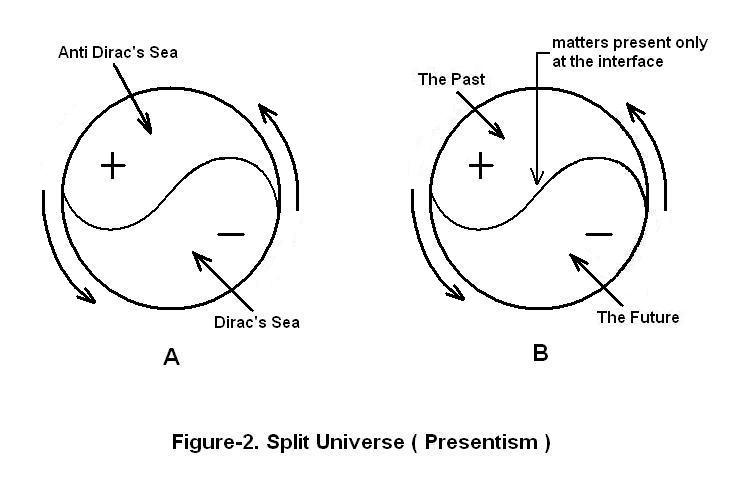
Even when Dirac proposed the existence of the ocean of [occupied] negative energy state c), nobody was cautious enough to give this Dirac’s sea its proper geographical place in the spacetime which should be next to the positive energy ocean, the anti-Dirac’s sea (Figure-2A).
Sooner or later, the mainstream physicists should adopt a 4-dimensional split universe in which the positive and negative energy exist together separated by a 3-dimensional interface (4-dimensional hypersurface with a very thin thickness d)) in between.
As we have previously elucidated, such interface does not separate neatly the positive and negative in a globally consistent way, in the sense that it e is extremely unstable.  It even barely exists, perpetually appears and disappears in and out of the existence.
This 3-dimensional interface, the physical space that we experience in, is nothing but the unit of time we call the present time (Figure-2B). The perpetual formation and dissolution of this present time are what we usually perceive as the time passage. It is such an idea that philosophers call presentism.
As in Galilean dynamics, we have not just one space but a different space e) for each moment in time. Space evaporates completely as one moment passes, and reappears as a completely different space as the next moment arrives 2. It is the factual reality that, alas, the mainstream physicists including Penrose himself rule out.
The material things exist strictly in the 3-dimensional interface (the present time), not in the outside of it. Matters appear and disappear at this 3-dimensional "screen" as the projection of the positive and negative energy interaction. In a close look, even in the place where there is no matter we can see virtual particles briefly jiggling violently in and out of the existence.
The 3-dimensional "interfacial tension" which keeps away the interface [and all matter within] from falling apart is what we call the gravitational constant. There are no such gravitational waves that propagate across the spacetime. Their propagation is limited to this sheet of the 3-dimensional interface which appears and disappears "through time" as a single whole.
Finally, this 3-dimensional interface which thickness is equal to the Planck distance (10-33 cm), the thinnest scale that nature allows, is perpetually created and annihilated at the rate equal to the speed of light, an enigmatic constant that physicists hitherto has taken as a gift from above. Naturally, no matter can move exceeding the speed limit that is equal to the rate of its perpetual creation [and annihilation].
Notes:
a.  In quantum mechanics, the momentum p may be replaced (quantization trick) by -iħ∂/∂x
b. Sometimes it is called a block universe. In such a world, matters may exist throughout the whole spacetime in an equal footing put in order by a light-cones framework. There is no definite place for the present time, past and future in such a framework, which Einstein worried so much. Philosophers call such a block universe’s idea eternalism.

c.  After he finally became convinced that the negative frequency solutions of the relativistic energy formula cannot be [mathematically] eliminated.
d.    The thickness (in the direction of its fourth dimension) of this interface is about 10-33 cm in which the quantum mechanics prevails.
e.   Even Minkowski described his spacetime in a similar way 3: "we should then have in the world no longer space, but an infinite number of spaces, analogously as there are in three-dimensional space an infinite number of planes. Three-dimensional geometry becomes a chapter in four-dimensional physics". Had he added that all those spaces are just potential - no matter of their normal directions point to - and only one space appears in a brief moment, he would be presentist.
References:
1.    Penrose. R.: "The Road to Reality," Vintage Books, London, 2005, p. 614-616.
2.    Ibid, p. 387
3.    Einstein, A. et al.: "The Principle of Reality," Dover Publication Inc.,  New York, 1952, p.79-80.Bottom of Form


Share/Bookmark

Wednesday, December 1, 2010

Symmetry and Symmetry Breaking

The asymmetry and its associated diversity that we observe today was the result of symmetry breakings which occurred in the early stage of the cosmos. In the beginning, a), the conditions were very different from those prevailing today, they were symmetric. The spatial dimensions as we know today did not yet exist; all dimensions were inherently temporal. However, as those temporal dimensions were yet undivided, there was no past, present b) and future.
At those conditions, the energy c) was unstable and tended to break into its positive and negative components. When it happened, the associated 4-spacetime (cosmos) d) was split into two parts creating an interface (3-hypersurface) in between the two. The dimensions across the interface transformed into spatial; leaving the dimensions outside it remained intact e).  Space, therefore, was born.

The two opposing energies f) perpetually generated sort of 4-lights (quantum fields) piercing through the interface (space) inducing secondary 3-(classical) fields which permeated and propagated across the interface (Figure-1A). As the quantum fields hit the interface, the strongest of them (Higgs fields) generated bright sparks which immediately disappeared as the opposite fields annihilated them (Figure-1B).
The fundamental particles as we know are in reality nothing but these quantum-sparks which perpetually appear and disappear at the interface. As those quantum fields hit the entire surface of the interface and penetrate it only a short distance (across through the thickness of the space), they seem to us (who live in such interface/3-space) as eternal, omnipresent and invisible objects that can create and annihilate quantum particles.
Minkowski 1, g) brilliantly fused the space and time into its undifferentiated state and brought back the spacetime into its original condition. However, then, something wrong happened. Instead of bringing the spacetime back into its symmetrical condition, Einstein2assumed that such unification did not make the temporal and spatial dimensions equivalent. Einstein failed to recognize that the asymmetry as we see today was the result of the spacetime symmetry breaking. This blunder has hampered the progress of physics for more than one hundred years now.
On the discovery of the four-dimensional spacetime, Einstein3 commented: “The non-mathematician is seized by a mysterious shuddering when he hears of four-dimensional things, by a feeling not unlike that awakened by thoughts of the occult.” No wonder, even after one hundred years of experience dealing with such spacetime, physicists are still bewildered and fail to recognize that their chaotic spacetime model does not represent the post symmetry breaking we observe today.
Supersymmetry Breaking and Multidimensional Worlds
The symmetry breaking of the 4-spacetime as we previously described was only one of the long series of successive symmetry breakings. It was the last of the long chain of a successive splitting of a higher-dimensional spacetime into its lower-dimensional parts.
To make it clear, let us take the ambient 10-spacetime as a start. As this 10-spacetime broke its supersymmetry, a 9-hypersurface came into being along with its associated temporal dimension, t7.  The latter, in turn, was split creating a smaller 8-hypersurface and its associated time, t6 and so forth. This series of splits continued resulting in successive creations of the spacetimes in descending order of their dimensions and ended when the 3-space came into being along with its associated time t1. A total of seven worlds h) have successively come into being with their own time, ti, light and its respective speed, ci, Planck constant, hi, and “gravitational” constant, Gi.

We can depict those seven worlds in term of their relative dimensionality (Figure-2.) or pictorially described as concentric spheres whose dimensions are larger outwards, in which the innermost layer is the 3-space with all of its solar system, stars, galaxies and super-galaxies (Figure-3A).
It is worthy to note that this picture may clarify the exact physical meaning of the ancient cosmology. For hundreds of years, people had wrongly considered this configuration as the geocentric cosmology in which the earth was at the center of the universe (Figure-3B). Even now, modern physicists fail to properly grasp the multidimensionality of the seven heavens described in the ancient cosmology 4.
Notes:
a.    It is the relative beginning, not the beginning of time.
b. The notation of spacetime given for the cosmos at its original state is misleading as it gives the impression as it was asymmetrical from the beginning. It would be more appropriate if we use the notation world, cosmos or more technically [metric] manifold.
c.  Energy in its entirety (4-energy); to avoid misunderstanding it would be more appropriate if we use the ancient notation: eon or simply eon.  The energy as we know is merely its superficial property (3-energy).
d.  There was no space, as space and the present time are different aspects of the same thing.
e.  This symmetry breaking is analogous to the phenomenon which occurs in the separation of two immiscible liquids, such as oil and water. In the body of the liquids, the cohesive forces are symmetric exerting equally in all directions. At the interface, however, such symmetry is broken because of unbalanced force exerting at the interface. As the system is in equilibrium,  the potential energy known as interfacial tension counter the net unbalance force. In terms of coordinate geometry, we may say that the interfacial tension differentiates the dimensions across the interface ("superficial" dimensions) from those of the original.
f.   The relativistic energy is composed of two opposite components as expressed in E2 = m2c4 + p2c2
g.  Minkowski died one year only after the discovery, leaving confusion on his discovered object (spacetime)’s structure.
h.   The ancients called such worlds seven heavens.

References:
1.  Einstein, A. et al.: " The Principle of Relativity," Dover Publications, Inc., New York, 1952, p. 75.
2.    Einstein, A.: " The Meaning of Relativity," Princeton University Press, Fifth Edition, New Jersey, 1954, p. 31
3.  Einstein, A.: "Relativity," Crown Publishers Inc., Fifteenth Edition, New York, 1952, p.55
4.  Hawking, S.: "A Brief History of Time," Bantam Books, London, 1989, p. 3.


Share/Bookmark