Pages

Showing posts with label Occam razor. Show all posts

Tuesday, October 2, 2012

Space Thickness

The relativity theory covers the macroscopic aspect of the world conceptualized as a flat or curved hypersurface.  However, hardly anybody is aware that we may incorporate the quantum phenomena into the theory by merely taking into account the hypersurface's thickness, its microscopic scale. We call such a unified theory the Grand Relativity Theory (GrRT).

Any physical object should have a thickness a) regardless of its dimensions; otherwise, it would disappear into thin air. Our physical space is no exception. The effect of space thickness, yielding a higher degree of freedom for particles to maneuver, intensifies as we probe to smaller distances approaching the thickness' magnitude (Figure-1).  

This scenery is spectacularly demonstrated by the string theory which, albeit of its imperfectness, can [mathematically] discover the ten-dimensionality of the ambient space. Whether the string theorists can properly portray such higher-dimensional space or not is a different story.

GrRT posits, on the contrary to the classical theory's premise, that the 4-dimensional spacetime doesn't at all represent the real but the primitive world. Inherently, the spacetime is symmetric, static and eternal. As such, all of its dimensions are entirely equivalent.

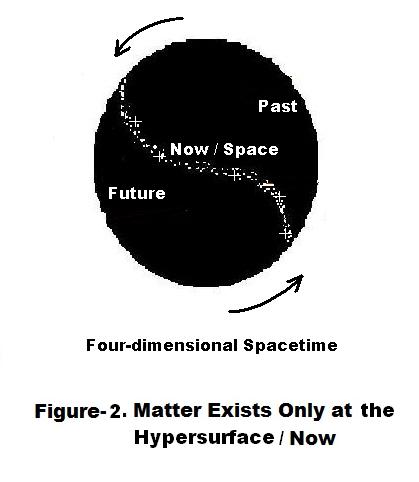
It is only when the spacetime splits in two b) that the dimensions are differentiating themselves into spatial and temporal. Following this spontaneously symmetry breaking, a thin 3-dimensional interface (hypersurface) c) is taking place in between the two halves of the split spacetime.

Now, the interfacial tension that holds the interface intact makes the dimensions extending along the hypersurface tenser and more "tangible" than that normal to it. We call the above dimensions spatial while the latter we call temporal. The hyper-interfacial tension which is responsible for this differentiation we recognize as the Gravity Constant.

The fourth [temporal] dimension extending normal to the hypersurface manifests the dynamical aspect of the world. The space thickness measured along this dimension is extremely thin, around 10 -33 cm or equivalent to 10 -44 second, the minimum thickness that nature allows, below which space and time have no meaning.

Because of its small thickness, the hypersurface is inherently unstable. Such a space barely exists, perpetually appears and disappears which makes the world extremely dynamic.

The size of the space thickness which determines the duration of space's presence we call now. Space and the now are the different aspects of the same thing. We perceive the sequence of space's appearance, presence, and disappearance as the successive transformations of the future into now and the past.

Matters exclusively present at now. They exist only along the thin hypersurface (space), not outside of it, which is nothing but pure energy d). The parts of the spacetime on either side of this thin space, we call the future and the past (Figure-2).
The extension of this concept for higher dimensional spacetime is straightforward, except that there come about successive spontaneous symmetry breakings. A hypersurface of one dimension lower than its embedding space, together with its corresponding temporal dimension, is created every time the split occurs.

Within the ten-dimensional ambient spacetime which the string theory reveals, a total of seven successive splits have taken place before our dynamical world comes to the existence. We thus have seven worlds embedded one within another, each with its corresponding temporal dimension.

Multidimensional time is still an alien concept for physicists. Physicists thought that the only vast and extended world existing in nature is that of four-dimensional. They believe that time is unique, the only dimension of its kind. The extra-dimensions, if they exist, should be spatial and curled up into extremely tiny loops.

This premise makes the task of string theorists extremely untenable as there are around 10500 possible ways on how the extra-dimensions may curl up. Nobody is crazy enough for not using the Occam’s razor to get rid of such problem and for good.

Notes:
a.   A physical object may have some thicknesses depending on the ambient space dimensions we take into account. Within our 3-dimensional ambient space, a 2-dimensional plane has one thickness, while the 1-dimensional thread has two thicknesses.
b.     The energy which is inherently composed of the opposing components tends to break up into its component, i.e. the positive and negative energies.  When this happens, the spacetime which is nothing but the geometrical manifestation of the [vacuum] energy, splits into two halves creating a hypersurface in between the two.
c.    We use the notation of space, hypersurface, and interface interchangeably. The hypersurface is a straightforward generalization of the concept from the geometry of surfaces embedded in the three-dimensional Euclidean manifolds.
d.    The mainstream physicists portray the 4-dimensional spacetime, dubbed the world, as being filled with matters throughout the full extensions. There are no [microscopic] universal now, matters existing in the past, now and future "have" an equal reality, as such that time travel becomes possible leading to paradoxes and chaos.

Share/Bookmark

Wednesday, April 20, 2011

Multiple Time Dimensions, why not?


One of the biggest misconceptions deep-rooted in the human mind is the one-dimensionality of time. When physicists discover a theory that calls for multiple extra dimensions, such as the string theory, their first reaction is to assign those extra as spatial dimensions. They do so because they abhor the plurality of time a).

In order to give the reason for their invisibility, the physicists hypothesize that the extra dimensions are curled up into tiny loops b). However, as there are so many possibilities on how those extra-dimensions may be curled up, the outcomes of such string theory can reach billions.  It gives us a good reason to allow the Occam razor getting rid of this dire hypothesis without delay.

Internal symmetry

The second reason for the invisibility of the extra-dimensions is that they are time dimensions. A world with multiple space and time dimensions certainly complies with the principle of the relativity. We would have in our worlds no more bizarre things such as donut-like or Calabi-Yau tiny manifolds. As such, the world may preserve its internal symmetry in which changing [reversibly] the time dimension with the space dimension leaves the physical laws identical. 

It is evident that the physical laws' formulation in the world with many time dimensions would be exceedingly complicated. However, we may have a more natural way to solve the formulation by transforming all but one time dimensions into space dimensions. Having done that,  we get a simple system of higher-dimensional space with only one temporal dimension without altering the outcome of the result. 

To give an illustration, let us take the example of our space (or 3-brane as you wish c)) which we interpret as embedded in a 10-ambient spacetime. Under multiple time dimensions framework, such a system consists of three space dimensions and seven temporal dimensions. By transforming all temporal dimensions  (except the highest dimensional one) into space dimensions, we get a system having nine space dimensions and one temporal dimension  (a 9-brane embedded in the same 10-ambient spacetime). The physical laws' formulation in the latter system is much simpler than that in the first one d).

Under such a system we can also transform only some of the time dimensions into space dimensions and keep the remaining intact. As such, we would have various dimensional branes ranging from 3-brane to 9-brane embedding in the same 10-ambient spacetime without even changing the outcome of the result. 

These are the various dimensional branes which we encounter in the superstring theory. However, in most of the cases, each of those branes is assumed to have only one temporal dimension. As such, the physicists who deal with those branes have not any simple way to solve the respective formulation e). 


Even in dealing with the 9-brane, we may have no good solution. We may, in this case, extend the dimensions of the ambient spacetime higher and higher until we get the solution f). 

We may say that the higher the brane's dimensions are, the flatter it is.  This situation makes the mathematical formulation of the physical laws simpler.

Figure-1 diagrammatically shows how events which are not simultaneous at a particular time dimension t1 become simultaneous at a higher time dimension t2. It is as though space flatten out as the number of temporal dimensions becomes higher that makes the physical laws formulation more straightforward g).

Notes:

a)   Physicists wrongly regard the 4-spacetime as having three space dimensions and one temporal dimension which should be inherently multidimensional. The underlying of what we know as 4-spacetime is 4-dimensional time having a 3-dimensional cross-section (3-brane) in it.

b)   Kaluza and Klein first introduced Kaluzathe idea to unify the electromagnetic field with that of gravity by adding the curly fifth dimension to the classical four. Later on, the idea is extended for much higher dimensions in which the loop size of the extra dimensions is at the order of Planck size (10-33 cm).

c)  We use the notations of space, hypersurface, hyper-interface or brane interchangeably.

d)   A system consisting of 3-space embedded in 10-dimensional ambient spacetime can be formulated as Hypercomplex function:

q = x1 +x2 + x3 + ic1t1 + jc2t2 + kc3t3 +lc4t4 + mc5t5 + nc6t6 + oc7t7 

under a coordinate patch consisting of three real x1, x2, x3 and i, j, k, l, m, n, and o as independent imaginary numbers as the basis coordinate representing seven different time dimensions, ci is the speed of light of the respective temporal dimensions ti .
It is identical to Octonion :  

q = x + ic1t1 + jc2t2 + kc3t3 +lc4t4 + mc5t5 + nc6t6 + oc7t7 

where x = x(x1 , x2 , x3)

The physical laws prevailing in such a system would be extremely complicated. Under the internal symmetry, we can make it much simpler by changing the extra time dimensions into spatial ones transforming the system to get a system consisting of 9-space embedded in 10-dimensional ambient spacetime.

Its mathematical formulation then becomes a simple ordinary complex number:

q = x1 +x2 + x3 + x4 +x5 + x6 + x7 + x8 + x9+ oc7t7

Denoting x = x (x1, … x9), we get a simple form:

q = x + oc7t7

e)   For example, if we have a system consisting of 6-brane embedded in 10-ambient spacetime (a system with 6 space dimensions and 4 time dimensions): 

q = x1 +x2 + x3 + x4 +x5 + x6 +lc4t4 + mc5t5 + nc6t6 + oc7t7 

Usually we consider such a system having only one time dimension and disregard the other three: 

q = x1 +x2 + x3 + x4 +x5 + x6 +lc4t4 

the solution of this formulation would be the only approximation of the former.

f)   The dimensions of macro-cosmos are assumed to be [quasi] infinite. It happened that we need only an ambient spacetime having 11 dimensions embedding a 10-brane  as in the case of supergravity theory.
g)   In such a diagram, simultaneous events would flatten their loci, an n-surface (hyperinterface, brane) embedded in (n+1) ambient spacetime; otherwise, the surface would not be flat. Figure-1B shows events which happen simultaneously at a certain time dimension t2 while they do not happen simultaneously at a lower time dimension t1 (Figure-1A).


Share/Bookmark