Pages

Showing posts with label spontaneous symmetry breaking. Show all posts

Wednesday, April 17, 2013

What’s Wrong with Dirac Sea’s Existence?


The attempts to incorporate the special relativity principle into quantum mechanics always leads to the solution of negative energy states pairing with positive energy states. Klein-Gordon's and Dirac equations are among those having such property.  However, physicists cannot afford to take on such energy's negativity as physical reality since they believe that it may lead to a catastrophic instability of the entire universe.

The root of the problem comes from the solution ambiguity of the relativistic expression for energy, E = ± (m2c4 + p2c2½. In classical physics, one can straightforwardly keep the solution bearing positive values separated from that taking the negative ones.  In quantum mechanics, however, things become complicated. One should then deal with operators acting on complex functions, giving way two square roots of complex-number terms that do not tend to separate neatly into positive and negative in a globally consistent way 1.

But this is what happens in reality. In the real world, those two opposite energies split only momentarily before they once again mingle together. This phenomenon repeats itself, making the 3-interface between those two energy oceans appear and disappear perpetually.


This interface, the 3-dimensional space we live in, seems to be something that evaporates completely as one moment passes and reappears as a completely different space as the next moment arrives two, which makes our universe incredibly dynamic.

Such as the beautiful translation of the mathematics formulation to the deeper workings of the physical universe may go beyond most people's wildest imaginations. Alas, even a prominent mathematical physicist such as Roger Penrose, has missed such insight. This continuous "catastrophic" instability that he was worrying so much is, in fact, the underlying reality of dynamic time. The energy's duality and polarity are the most fundamental of the relativity principles, the cosmos' prime mover, without which the world would remain sterile, timeless, and standstill.

When Dirac formulated his equation, being unable to get rid of the unwanted negative energy. He posited the presence of the sea of negative energy states, later known as the Dirac Sea. However, physicists are not comfortable with such a bold idea and reinterpret it as corresponding to antiparticles with positive energy.

Dirac, alas, didn't elaborate further about his energy sea, such as its location, how it came to be, etc. The answer is, in fact, relatively simple. The Dirac Sea must be present side by side with the sea of positive energy we refer to as anti-Dirac Sea (Figure-1). Both of them should be 4-dimensional conforming to the dimensionality of the spacetime they "occupy." The 3-dimensional interface naturally occurs between the two energy seas is nothing but the physical space we inhabit.

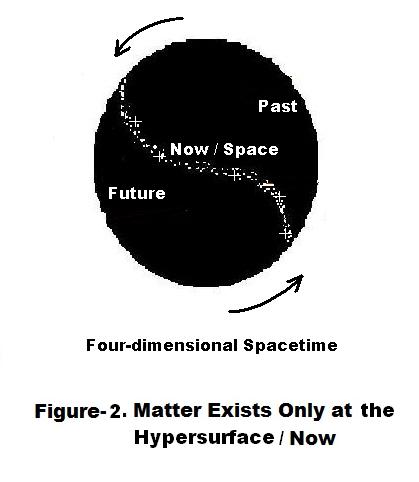
This kind of depiction greatly facilitates us in describing quantum fields, which so far seem to appear from nowhere, omnipresent, capable of creating and annihilating quantum particles. The interaction between the opposing energy potencies in Dirac and anti-Dirac seas giving rise to quantum fields, piercing through the 3-interface igniting quantum sparks ("quarks"), which appear and disappear perpetually on its surface (Figure-2).

Having elaborated that, we can now explain Fred Hoyle's C-field in a similar way. Hoyle hypothesized the existence of something similar to the Dirac Sea that continuously generates the fields. He further posited that the C-field had negative pressure and drove the expansion of the universe.  
Subsequently, within the context of the standard model, Peter Higgs introduced fields, which later bore his name, capable of stimulating particles to acquire mass. Alas, he was silent about the nature and origin of Higgs fields or the existence sort of negative energy sea.

Another fundamental relativity principle underlying any process of creation is the spontaneous symmetry breaking. A preexisting energy sea, later on, splits into positive and negative energy (Dirac anti-Dirac seas) as what they are now. However, that symmetry breaking doesn't take place all at once but gradually (Figure-3), giving us a perception that the universe is expanding. This hypothesis is evidence against that of the "quantum" primordial explosion of Big Bang theory.

References:

1.     Penrose, R.: ”The Road to Reality," Vintage Books, London, 2005, p. 615
2.     ibid, p. 387


Share/Bookmark

Tuesday, October 2, 2012

Space Thickness

The relativity theory covers the macroscopic aspect of the world conceptualized as a flat or curved hypersurface.  However, hardly anybody is aware that we may incorporate the quantum phenomena into the theory by merely taking into account the hypersurface's thickness, its microscopic scale. We call such a unified theory the Grand Relativity Theory (GrRT).

Any physical object should have a thickness a) regardless of its dimensions; otherwise, it would disappear into thin air. Our physical space is no exception. The effect of space thickness, yielding a higher degree of freedom for particles to maneuver, intensifies as we probe to smaller distances approaching the thickness' magnitude (Figure-1).  

This scenery is spectacularly demonstrated by the string theory which, albeit of its imperfectness, can [mathematically] discover the ten-dimensionality of the ambient space. Whether the string theorists can properly portray such higher-dimensional space or not is a different story.

GrRT posits, on the contrary to the classical theory's premise, that the 4-dimensional spacetime doesn't at all represent the real but the primitive world. Inherently, the spacetime is symmetric, static and eternal. As such, all of its dimensions are entirely equivalent.

It is only when the spacetime splits in two b) that the dimensions are differentiating themselves into spatial and temporal. Following this spontaneously symmetry breaking, a thin 3-dimensional interface (hypersurface) c) is taking place in between the two halves of the split spacetime.

Now, the interfacial tension that holds the interface intact makes the dimensions extending along the hypersurface tenser and more "tangible" than that normal to it. We call the above dimensions spatial while the latter we call temporal. The hyper-interfacial tension which is responsible for this differentiation we recognize as the Gravity Constant.

The fourth [temporal] dimension extending normal to the hypersurface manifests the dynamical aspect of the world. The space thickness measured along this dimension is extremely thin, around 10 -33 cm or equivalent to 10 -44 second, the minimum thickness that nature allows, below which space and time have no meaning.

Because of its small thickness, the hypersurface is inherently unstable. Such a space barely exists, perpetually appears and disappears which makes the world extremely dynamic.

The size of the space thickness which determines the duration of space's presence we call now. Space and the now are the different aspects of the same thing. We perceive the sequence of space's appearance, presence, and disappearance as the successive transformations of the future into now and the past.

Matters exclusively present at now. They exist only along the thin hypersurface (space), not outside of it, which is nothing but pure energy d). The parts of the spacetime on either side of this thin space, we call the future and the past (Figure-2).

The extension of this concept for higher dimensional spacetime is straightforward, except that there come about successive spontaneous symmetry breakings. A hypersurface of one dimension lower than its embedding space, together with its corresponding temporal dimension, is created every time the split occurs.

Within the ten-dimensional ambient spacetime which the string theory reveals, a total of seven successive splits have taken place before our dynamical world comes to the existence. We thus have seven worlds embedded one within another, each with its corresponding temporal dimension.

Multidimensional time is still an alien concept for physicists. Physicists thought that the only vast and extended world existing in nature is that of four-dimensional. They believe that time is unique, the only dimension of its kind. The extra-dimensions, if they exist, should be spatial and curled up into extremely tiny loops.

This premise makes the task of string theorists extremely untenable as there are around 10500 possible ways on how the extra-dimensions may curl up. Nobody is crazy enough for not using the Occam’s razor to get rid of such problem and for good.

Notes:
a.   A physical object may have some thicknesses depending on the ambient space dimensions we take into account. Within our 3-dimensional ambient space, a 2-dimensional plane has one thickness, while the 1-dimensional thread has two thicknesses.
b.     The energy which is inherently composed of the opposing components tends to break up into its component, i.e. the positive and negative energies.  When this happens, the spacetime which is nothing but the geometrical manifestation of the [vacuum] energy, splits into two halves creating a hypersurface in between the two.
c.    We use the notation of space, hypersurface, and interface interchangeably. The hypersurface is a straightforward generalization of the concept from the geometry of surfaces embedded in the three-dimensional Euclidean manifolds.
d.    The mainstream physicists portray the 4-dimensional spacetime, dubbed the world, as being filled with matters throughout the full extensions. There are no [microscopic] universal now, matters existing in the past, now and future "have" an equal reality, as such that time travel becomes possible leading to paradoxes and chaos.

Share/Bookmark