Pages

Monday, February 20, 2012

The Brain and Universe as Hologram

Despite its enormous size and apparent materiality, the universe does not exist of itself. Indeed, hardly anybody is aware that the universe and everything within including ourselves a), is perpetually created and annihilated to and fro energy at the rate equal to the speed of light. The formation and dissipation of this wave-like material world across the surface of the vast ocean of energy create what we perceive as the passage of time.

In Bohm’s notion this dynamic phenomenon is called the unfoldment of the implicate order and enfoldment of the explicate order, like what implies in the hologram b). According to Bohm, the universe is like a kind of colossal dynamic hologram or holo-movement.
Our world and everything within is only shadows, mere projections from reality beyond our ordinary space and time. However, if it was so, how come that we perceive the world around us continuous and persisting over time? The simple answer is that nobody can see the discontinuity of time which interval is in the order of 10-44second.
However, the argument does not stop there. The amazing thing is that nature seems to conform to the working of the human brain to that of the universe. Karl Pribram, a neurophysiologist at Stanford University, discovered the brain works under the hologram mechanism. He found that memories were not localized at specific brain side but were somehow spread out throughout the brain as a whole. Every part of the brain contains all the information necessary to recall a whole memory, just like the hologram of which every small fragment of a piece of holographic film contains all the information recorded in the whole.

Pribram concluded that if the brain works following the holographic model then so does the universe. Even though Pribram and Bohm worked independently, they arrived at the same conclusion similar to what the mystics had said that the world around us was just an illusion. The universe and everything within existing only in a series of a fraction of seconds successively separated by gaps of nonexistence.

Both the brain and cosmos work at the same mechanism and rhythm which make human feel at home as they are unaware of experiencing such weird underlying reality.

Notes:

a.  What we mean here by oneself is the material body. Consciousness, information (knowledge) and intelligence are forms of more sophisticated energy which persist through time.

b.   Descartes who introduced coordinate systems to describe the order in physical process strongly influence our current concepts of order. The Cartesian grid and those of curvilinear coordinates essentially described a local order of separate points. The quantum realm, however, does not take this kind of local order and seems to have no significant order which Bohm called implicit or enfolded order. This kind of nonlocal order is what hologram does have.

References: 

1.  Talbot, M.: "The Holographic Universe," HarperPerennial, New York, 1992, p. 46-49
2.  Bohm, D. et al.: "The Undivided Universe," Routledge, London, 1993, p. 374-380.

Share/Bookmark

Monday, February 6, 2012

The Nothingness, Implicate Order and Non-locality

Most people wrongly perceive matter as an object existing in an empty space. Space is far from the vacuum, it is a plenum full of energy, the ground for all existence, inanimate and animate beings.

The matter is merely an ephemeral derivative of energy perpetually created and annihilated at the interface of the positive and negative energy as the result of the interaction of those opposite energies a). Despite its apparent materiality and enormous size, this interface - the 3D-space and its content (universe) - does not exist in and of itself. Together with the matter, it contains, space perpetually appears and disappears at the rate equal to the speed of light creating a dynamic dimension which we call time.

In a deeper reality, this dynamic ephemeral space might be described as a front wave propagating at the speed of light across an unimaginably vast ocean of high energy (Figure-1A). This front wave perpetually rises and dissipates above and to the surface of the ocean, manifesting respectively, using Bohm’s terms, the unfoldment of the implicate order and the enfoldment of the explicate order b).


It is only at this wave structure (unfolded order) that every materialized thing is localized. In this front wave, the universe where we live, the local order implies. Its surrounding (enfolded order), in front and behind the wave as well as in the vast ocean beneath it, is non-local c). The surrounding of our universe, the undisturbed vast ocean of energy, which we used to think as nothingness, is, in fact, a real plenum. Nothingness, emptiness, vacuum, nonexistence d) or whatever you call it is just pure human imagination.

Bohm was awfully correct when he stated that because the implicate order is the foundation that has given birth to everything in our universe, this infinite sea of energy must contain every configuration of matter that has been or will be created, energy, information (knowledge), consciousness, intelligence, and life e).

But again Bohm had no idea on how to describe physically these deep layering realities. He talked about super-implicate order by extending the notion of implicate order to quantum fields instead of particles f). The whole idea of implicate order could be extended in a natural way implying indefinitely higher levels of implicate order. In order to visualize the Bohm’s idea, we may enhance it by figuring out that each of those multi-layered implicate orders (energy, information, consciousness, intelligence, and life) is embedded one within another, in successively higher and higher dimensions (Figure-1B, C and D) g).

Notes:
a. The 4-dimensional spacetime is split into two parts as the positive and negative energies segregating from each other. The interface of these opposite energies is the 3-dimensional [hyper] surface on which particles are created as the result of those energies’ interaction. This interaction takes place as the quantum fields generated by the opposite energies piercing through the interface igniting quantum sparks we perceive as particles.   
b.  Bohm 1 described the universe as a comparatively small pattern of excitation, a ripple on the infinite ocean of energy which is a deeper order enfolded in the warp of the reality. Bohm failed to elucidate his idea more explicitly by describing geometrically i.e. the relative dimensionality of the ripple vis-a-vis that of the ocean of energy. As such, his description of the universe in term of implicate and explicate order was blamed to be merely a metaphor.
c.   Our classical notions of localized order imply in spacetime arise as limiting cases of the deeper implicate order. The manifest level of ordinary experience and the quantum level underlying it emerge from a still deeper implicate level in which the classical Cartesian notions of form, order, and structure have more or less dissolved. Bohm believed that the implicate order would be more suitable for expressing the basic laws of nature than the explicate order which is only a particular case of the general order.
d.    Nothingness in the sense of an absolute term in which it is devoid of matter as well as energy or anything else. 
e.  We may call all of the later (information, consciousness, intelligence, and life) energy but in different degree of sophistication (dimensions).
f.     There is indeed no distinction between the fields and spacetime itself.
g.   The dimensions shown in the figure are relative. We should bear in our mind that each of those individuals (energy, information, consciousness, intelligence, and life) may have different levels of existence and, those, the variety of their dimensions.

References: 
1.    Bohm, D. et al.: “The Undivided Universe”, Routledge, London, 1993, p. 374-380.
2.    Talbot, M.: "The Holographic Universe", HarperPerennial, New York, 1992, p. 46-49


Share/Bookmark

Wednesday, February 1, 2012

Quantum Annihilation and the Non-locality

The continuity of the passage of time we see in nature is not what it seems to be. It is more like the continuity of the pictures we see in the movie which are in reality the projection of a series of discrete pictures which gives us a perception of seeing events running continuously through time. While the pictures taken for the movie consisted of a series of two-dimensional images separated by gaps, those of the universe consist of a series of 1044 snapshots of the whole three-dimensional space per second separated consecutively by a gap of nonexistence (Figure 1A).

The appearance of the space together with everything it contains is what we call the present time, promptly followed by its disappearance dissolving everything into nonexistence a) we call the past. This alternation of the existence – nonexistence is what we perceive as the passage of time b)

Why does universe seem to be so over-designed in that the inclusion of a series of wasteful nonexistence is required? Far from being futile, this gap of nonexistence is strongly needed as the means to preserve the universe as a single whole regardless of the limitation of the light speed which in this case is not applicable.

Space together with everything within dissolves entirely in such a gap of non-existence. As the locality has no longer any meaning, the state of nonexistence manifests the undivided wholeness. All become united and entangled in which the implicate order of non-locality implies c).

The state of existence which is the unfoldment of the implicate order of non-locality manifests the explicate order of locality d). The perpetual creation and annihilation, therefore, fashions alternately the locality and non-locality orders (Figure-1B). These succeeding unfoldment of the implicate and enfoldment of the explicate orders take place at the rate equal to the speed of light. Alas, David Bohm1 who first proposed the theory of the implicate order did not elaborate it to this direction, which makes people consider his theory as a mere metaphor.  


The gross sum of contributions of those explicit-implicit orders or local-nonlocal orders e) is mathematically described by what is called the wavefunction. As the quantum measurement can only gauge [the snapshot of] the explicate order, and not the complete series of the implicate-explicate orders, it gives us a perception as though the act of measurement collapses the wavefunction.

The perpetual successive transformation of the local and non-local orders which is not in point-to-point correspondence makes the quantum probabilistic mechanism seem to take over the classical deterministic mechanism. 

Notes:
 
a.  In the state of nonexistence, everything dissolves into energy in which space and time has no meaning. It signifies that in such nonexistence the non-local order implies.
b.  It implies that there is no such [material] thing persists in nature. Everything "within" space perpetually appears and disappears "through" time, except the energy which alone persists. The persistence of matter and space are just an illusion.
c.  The enfolded order which applies within such a non-local unbroken wholeness is what David Bohm called the implicate order, taking the analogy of the "order" produced in a hologram where each of its regions makes possible an image of the whole object. Rather than being in point-to-point correspondence, the whole object is enfolded in each part of the universe.
d. As what is usually described using a Cartesian grid or its extension of curvilinear coordinates. Locality fits comfortably within the space structure which is mathematically described by a differential manifold.
e. Mostly all the laws of motion in quantum mechanics correspond to enfoldment and unfoldment. Bohm put forward that the relation between the wave function at one time and its form in another time is determined by the propagator or the Green's function. The region near a point in space enfolds contribution from all over space at other times and vice-versa in which the Green's function is taken as the weighting factor.

References:

1.  Bohm, D. et al.: "The Undivided Universe," Routledge, London, 1993, p. 350-355.
2.  Talbot, M.: "The Holographic Universe," HarperPerennial, New York, 1992, p. 46-49

Share/Bookmark

Wednesday, January 11, 2012

The Energy Equation that Physicists Don’t Fully Trust

Physicists have discovered that nature has a beautiful feature not only aesthetically but also mathematically which they call symmetry. The simplest symmetry we may get in nature is the pairing of fundamental particles such as that of particles-antiparticles or more complex [super] symmetry bosons-fermions. Even today physicists still tirelessly chase another particle’s symmetry i.e. super-partner particles which they yet find none.
  
Strangely enough, physicists don’t believe on the symmetry of energy, the most fundamental element of the reality, albeit the relativistic energy equation E2=m2c4+p2c2, plainly shows otherwise. This formula shows us the evidence that the energy exists in pairing - the positive and negative energy – regardless they are neatly separated or not from each other.

For physicists, the existence of negative energy together with the positive energy is bad news as such a situation may lead to a spontaneous transition from positive to negative energy resulting in a catastrophic instability. Alas, one cannot preserve the positive frequency requirement in quantum mechanics whose wavefunctions are essentially complex a). The two square roots of a complex number expression do not tend to separate neatly into positive and negative in a globally consistent way as what the physicists have expected1.  

Are we, then, faced with an impasse situation? Well, on everybody surprise we are absolutely not. On the contrary, the existence of the positive and negative energies is a fundamental feature that nature requires for the creation and reproduction of everything in the universe. Without such an opposite pair, the world would be sterile from anything material in which space and time have no meaning.


As far as the mainstream physics keep adopting the current single block b) universe "containing" no negative but positive energy to represent the actual world (Figure-1), we would forever stay with the crisis that today physicists are facing.

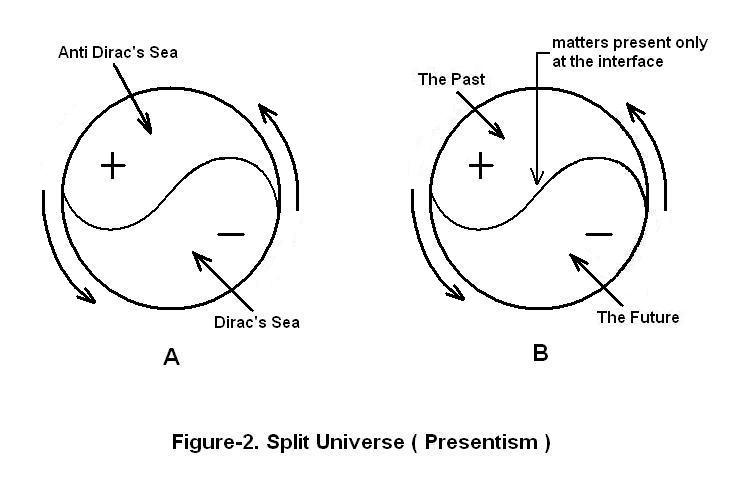
Even when Dirac proposed the existence of the ocean of [occupied] negative energy state c), nobody was cautious enough to give this Dirac’s sea its proper geographical place in the spacetime which should be next to the positive energy ocean, the anti-Dirac’s sea (Figure-2A).
Sooner or later, the mainstream physicists should adopt a 4-dimensional split universe in which the positive and negative energy exist together separated by a 3-dimensional interface (4-dimensional hypersurface with a very thin thickness d)) in between.
As we have previously elucidated, such interface does not separate neatly the positive and negative in a globally consistent way, in the sense that it e is extremely unstable.  It even barely exists, perpetually appears and disappears in and out of the existence.
This 3-dimensional interface, the physical space that we experience in, is nothing but the unit of time we call the present time (Figure-2B). The perpetual formation and dissolution of this present time are what we usually perceive as the time passage. It is such an idea that philosophers call presentism.

As in Galilean dynamics, we have not just one space but a different space e) for each moment in time. Space evaporates completely as one moment passes, and reappears as a completely different space as the next moment arrives 2. It is the factual reality that, alas, the mainstream physicists including Penrose himself rule out.
The material things exist strictly in the 3-dimensional interface (the present time), not in the outside of it. Matters appear and disappear at this 3-dimensional "screen" as the projection of the positive and negative energy interaction. In a close look, even in the place where there is no matter we can see virtual particles briefly jiggling violently in and out of the existence.
The 3-dimensional "interfacial tension" which keeps away the interface [and all matter within] from falling apart is what we call the gravitational constant. There are no such gravitational waves that propagate across the spacetime. Their propagation is limited to this sheet of the 3-dimensional interface which appears and disappears "through time" as a single whole.
Finally, this 3-dimensional interface which thickness is equal to the Planck distance (10-33 cm), the thinnest scale that nature allows, is perpetually created and annihilated at the rate equal to the speed of light, an enigmatic constant that physicists hitherto has taken as a gift from above. Naturally, no matter can move exceeding the speed limit that is equal to the rate of its perpetual creation [and annihilation].
Notes:
a.  In quantum mechanics, the momentum p may be replaced (quantization trick) by -iħ∂/∂x
b. Sometimes it is called a block universe. In such a world, matters may exist throughout the whole spacetime in an equal footing put in order by a light-cones framework. There is no definite place for the present time, past and future in such a framework, which Einstein worried so much. Philosophers call such a block universe’s idea eternalism.

c.  After he finally became convinced that the negative frequency solutions of the relativistic energy formula cannot be [mathematically] eliminated.
d.    The thickness (in the direction of its fourth dimension) of this interface is about 10-33 cm in which the quantum mechanics prevails.
e.   Even Minkowski described his spacetime in a similar way 3: "we should then have in the world no longer space, but an infinite number of spaces, analogously as there are in three-dimensional space an infinite number of planes. Three-dimensional geometry becomes a chapter in four-dimensional physics". Had he added that all those spaces are just potential - no matter of their normal directions point to - and only one space appears in a brief moment, he would be presentist.
References:
1.    Penrose. R.: "The Road to Reality," Vintage Books, London, 2005, p. 614-616.
2.    Ibid, p. 387
3.    Einstein, A. et al.: "The Principle of Reality," Dover Publication Inc.,  New York, 1952, p.79-80.Bottom of Form


Share/Bookmark

Monday, December 12, 2011

Zeno’s Motion Paradoxes and Modern Physics


The special relativity theory began with the initiative of Lorentz who suggested a general hypothesis, something crude, startling and bold. From Morley and Michelson’s experiments he concluded that any moving body must have undergone a contraction in the direction of its motion, and with a velocity v, a contraction in the ratio of 1: (1-v2/c2)1/2. He assumed that molecular forces, like the electric and magnetic forces, were also transmitted through the ether. The translation would affect the action between two molecules or atoms in a manner resembling the attraction or repulsion between charged particles. Since the intensity of molecular actions ultimately conditions the form and dimensions of a solid body, there is a possibility to be a change of dimensions as well.


Combined with the hypothesis of time dilatation that Einstein subsequently put forward, Minkowski proved that, by unifying space and time called spacetime, the world configuration was 4-dimensional rather than the ordinary 3-dimensional. He demonstrated that the Lorentzian hypothesis was much more intelligible when explained under this new conception of space and time. For him, the length contraction was not to be looked upon as a consequence of resistance in the ether or anything of that kind but merely as a gift from the above, - as a companion circumstance to motion 3.

The problem of motion is not only the subject of modern physicists but had already become a brainteaser for the ancient people. For the ancients, the motion was different from the appearance they saw in daily life but rather the inner principle of change in nature. For over two millennia nobody offered better clues about more profound nature of motion than Zeno of Elea (ca. 490 - 430 BC) even over more modern scientist such as Newton and many others. Among his famous 60 paradoxes, only one of the most profound puzzles of mystery survives to our time, i.e., the flying arrow paradox, a) thanks to Aristotle who preserved them in his book of Physics.

Zeno raised the question about the continuation of space and time that even today's quantum physicists are struggling. Zeno saw that time consisted of a series of indivisible instants which make it impossible for something to move during a period at such an indivisible instant. He argued that an arrow would remain stationary if it occupied the same space at every indivisible instant. For Zeno, being at rest means that from one instant to another different instant, the body in question and all its parts occupy the same place 1. Zeno hypothesized that for a motion to occur, an object must change the position which it occupies; thus, it should be shortening. 

However, still, Zeno missed the explanation on how the mechanism of shortening worked. We are not ashamed of helping Zeno by taking an example of a looper caterpillar’s motion. The method of this animal locomotion is incredible because of a walking style on two widely spaced groups of legs. At the front, just behind the head, are three pairs of small, segmented legs ending in tiny claws that help to grab onto plant material. Then, towards the end of the muscular and quite powerful body, a few more pairs of non-articulated fleshy lobes act as the hind legs. This set-up is perfect for creating the looping motion when the caterpillar is moving about on the plant. It stretches the front legs out to where it wants to go, grabs onto the plant material, then drags the hind legs up, while the body forms an impressive loop, like the U letter upside down or the Greek letter omega (Ω). As such, the contraction and straightening of the looper body make it advance. 

With such comparison, under our new interpretation of quantum theory, we can now illustrate the motion of an arrow flying ahead across its trajectory (Figure-1). Let l1 be the length of the arrow flying following its path starting from an instant t1 to another instant t4.

Now, viewed at the quantum level in which the same arrow is the appearance of a series of different arrows consecutively created and annihilated (depicted respectively as the solid and dash-arrow). However, in such a moving body, the length of the arrow shortens to become l2 in the subsequent creation the length of answers the fundamental question which nobody dares to pose as why the Lorentz contraction occurs. 

It is, therefore, imperative to see this phenomenon in the other way round. We used to see the motion of the body as the cause, and its contraction is the effect. We do not see as what Zeno did, that as far as the length of the body remains the same (no contraction) at any and every instant, then the motion is impossible.


We may, therefore, conclude that the contraction is the prerequisite for the motion to happen. The shorter the body has undergone a contraction, the faster the motion of the body would be c).


We should, also, scrutinize the second part of Zeno argument which holds the indivisibility of instants during which motion is impossible to occur. Such argument was correct if such a series of instants continued with no gaps in between two consecutive instants, which is not the case (d). We have elaborated in the previous articles that the perpetual creation and annihilation, the underlying quantum mechanism, resulting in a motion-pictures-like which is a series of time gaps separating the ephemeral spaces (Figure-2).

We should, therefore, make up our mind that the arrow e) existing in any instant is entirely different from that of immediately annihilated in the succeeding instant. As such, the newly created arrow can always take a different position from that in the previous instant.

It is unbelievable that a man who lived in such olden time may have such a deep insight puzzling the reality of motion that can only be answered by the relativity theory and quantum mechanics f) which, alas, nobody is aware.

The 2500 years old Zeno flying-arrow paradox is in its every respect, thus, comprehensively solved.

Notes:
a)   Most scholars regarded that motion had fully explained and calculus could explain the dichotomy paradox. Some philosophers, however, say that Zeno's paradoxes and their variations are still relevant to metaphysical questions. The mathematical models of motion, space and time are merely intellectual constructions built for the convenience of simple calculations, not for the broader purpose of representing the structure of reality. The underlying reality that the paradox addresses is, thus, evaded.
b) The Lorentzian hypothesis is entirely equivalent to the conception of Minkowski spacetime which makes the hypothesis much more intelligible.
c)   The relativity theory asserts that a rigid body is shorter when in motion than when in rest. In this theory, the speed of light c plays the part of a limiting velocity, which can neither be reached nor exceeded by any real body.
d)  It is how we have to interpret the underlying reality that Zeno addressed in his dichotomy, one of Zeno's four famous paradoxes, which was expressed in ordinary [non-relativist] velocities, thus, easily refuted by anybody.
e) Against Zeno’s theory of the continuation of time, Aristotle argued that if time is continuous and the points of time are represented as points of space, then the point's position must be represented by both the past and future. For him the point of division lies in one segment or the other, but not in both. If a white object were changing to black in a period divided into two intervals – A, during which it is white, and B, during which it is black – then there must be some instant C when it is both black and white 2).
f)      This problematic, contradictory situation that C belongs to both A and B was not learned as it is repeated in modern time by the similar proposition of Schrodinger's cat paradox where the cat was potentially found both dead and alive at the same time.
g)     Microscopically prevailing over its quantum kinds of stuff.
h)   A newly interpreted quantum theory with the constant creation and annihilation of matter, to and fro energy, as its fundamental mechanics.

References:
1.     Mazur, J.: "The Motion Paradox," Dutton, New York, 2007, p. 41.
2.     Ibid, p. 40
3.   Einstein et al.: "The Principle of Relativity," Dover Publications, Inc., New York, 1952, p. 81


Share/Bookmark

Thursday, December 8, 2011

Eternalism vs Presentism


The relativity theory unifies space and time into a single 4-dimensional continuum called the spacetime.  Albeit their unity, however, the theory inexplicably assumes that the nature of dimensions at every point in the continuum differentiates into those of the space and time.

Such concept of spacetime sometimes is referred to as the block time, block universe or eternalism. We have considered time as having similar ontology to that of space, that future events are already there, and that there is no objective flow of time. The spacetime is viewed as an unchanging 4-dimensional block as opposed to the view of the world as a 3-dimensional space perpetually modulated by the passage of time 1.


This concept of the block universe adopted by mainstream physics makes the physics now in trouble. This concept is wrong both physically and philosophically. A continuum should have inherently similar dimensions at its every point, except there is a discontinuity or boundary a) along which the block's dimensions are transformed into spatial (Figure-1).


In our daily life, one observes the difference between the past, the present, and the future. One perceives that as time passes, the moment that was once the present becomes part of the past, and part of the future, in turn, becomes the new present. As such, we experience or at least perceive the passage of time, with a present moment moving forward into the future and leaving the past behind 2. Philosophically, such a view of time is called presentism.

As we explain in the previous articles, our concept about the spacetime continuum is in line with this presentism, except that everything exists ephemerally. As such, when the part of the [nebulous] future transformed into the new present, the moment that was once the present is annihilated into part of the [void] b) past. In this view, only the present is real, as opposed to eternalist idea that all points in time are equally real.


This act of perpetual creation and annihilation gives us the perception of time passage. This modified presentism accentuates the actuality of the present and its obvious difference from the potentiality of the future and the nullity of the past. Matters which exist only in the present are exerted by the gravity and held together as a single whole on the plane c) of the present.


In order that the cause and effect principle prevails in their "chaotic" block universe, the physicists are forced to set up a light-cones system in which the individual light-cone may have a different orientation (Figure-2). However, such a concept may lead us to a chaotic closed timelike curve three that questions the integrity of such physical edifice.

The physicists are unaware that in such a symmetric block universe, which is timeless and eternal, no matter can exist, neither movement nor changes can occur. Sooner or later the mainstream physicists should abandon their concept of the block universe which has led us to many misinterpretations such as determinism, time travel, many-worlds interpretation and so forth.

In the presentist universe, the block is spontaneously broken d) in two halves, creating a 3-dimensional interface in between the two as it is transforming the dimension along the interface into spatial. Space and the present time are, in fact, two different aspects of the same thing which is the smallest unit of time. The eternity is, thus, broken bearing perpetually the present moment which splits the past barely from the future.

Notes:

a). Such as an interface or a surface in the case of liquid-like or a fissure in the case of a solid-like continuum.
b). Void of matter but not of energy.
c). or a wavy surface or interface in order to be in line with the general relativity theory.
d). It may happen because of the segregation of a pair of energy's opposing elements: the positive and negative energy.

Reference:

2.  Ibid.
3.  Penrose, R.: "The Road to Reality," Vintage Books, London, 2005, p. 409.


Share/Bookmark